Showing posts with label ebola virus. Show all posts

Friday, October 31, 2014

Ebola virus - should I panic?

English: Color-enhanced electron micrograph of...
English: Color-enhanced electron micrograph of Ebola virus particles. Polski: Mikrofotografia elektronowa cząsteczek wirusa Ebola w fałszywych kolorach. (Photo credit: Wikipedia)
01-Nov-2014


This will be my first post on the current issue of ebola virus, which is taking the world in the outbreaks, the cause of which we know at least, and the scattered incidents of individuals who have worked in facilities, and have contracted the virus themselves.

Should I panic?

No. As always said by health authorities, with proper precaution and care, no. There is no reason to panic.

First, it is not like the common cold virus, which is airborne. If it is, then I would panic. But then again, I don't want to be ahead and worry without cause.

Second, even if I do contract the virus, the country where I live is prepared to handle the situation. As if everyone is entitled to say it, "Our health facilities and personnel are at par, if not the best in the world." So, why should I panic?

I don't even worry. That could lower my resistance, and that could make me susceptible to other known, though weaker, viruses, and it may not be the ebola virus that will bring me down.

So, are you worried? Are you panicking?

You should not.

Till then!

Saturday, May 23, 2009

Swine flu may be easy target for vaccine: study

Time is GMT + 8 hours
Posted: 23-May-2009 04:43 hrs
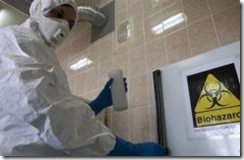
090523-0443hrs A Russian laboratory worker handles a vial containing the swine flu virus H1N1strain in St. Petersburg on May 13, 2009. The A(H1N1) swine flu strains spreading across the world react to antibodies in the same way, boosting the chances of a common vaccine for all of them, a study released in the United States Friday said. 

The various A(H1N1) swine flu strains spreading across the globe react to antibodies in the same way, boosting the chances of a common vaccine for all of them, a study released Friday in the United States said.

The study, published in Science, says the virus has probably been circulating unnoticed in pig populations for some time, and calls for more careful monitoring of swine populations.

It confirms that the new pathogen originated with pigs, and is a mix of a previously known virus that already contained avian, swine and human genetic segments with two other genes from Eurasian swine viruses never detected outside Asia before.

Understanding the origins of the novel A(H1N1) virus could help scientists prevent the pathogen from emerging in a new -- and potentially more virulent -- form, the researchers said.

"These findings are critically important for our global public health," said Nancy Cox, chief of the Influenza Division of the US National Center for Immunization and Respiratory Diseases in Atlanta Georgia and a co-author of the study.

"The new A(H1N1) viruses are antigenically similar, that is, they react to antibodies in a similar way," she told journalists in a teleconference.

"This makes our job of coming up with a reference candidate vaccine virus much, much easier," she said.

Cox cautioned, however, that the swine flu was very different than seasonal flu, meaning that vaccines designed for the latter probably would not work against both.

The number of confirmed swine flu infections worldwide topped 11,000 Friday, including more than 85 deaths, according to the World Health Organisation.

The US Centers for Disease Control reported 6,552 probable and confirmed cases in the United States, but said the real tally was probably 20 times higher.

"This is the tip of the iceberg -- We estimate more than 100,000 cases," Anne Schuchat, the CDC's Interim Deputy Director for Science and Public Health, told journalists.

While the rate of new US infections had tapered off over all, the virus remained "very, very active" in some regions, she said.

"We should expect to see more cases, more hospitalisations, and perhaps more deaths in the coming weeks," she said.

She cautioned Americans to take precautions over long holiday weekend, and especially to not travel with sick family members. The virus could continue to circulate in the summer "and come back in the worst way in the fall," she said.

For the study, scientists sequenced the genomes of more than 70 samples of the novel H1N1 flu, 17 from Mexico, and 59 from 12 states in the United States.

The study provides the first detailed analysis of the pathogen's genetic and antigenic -- how it reacts to antibodies -- characteristics.

It is still unclear whether the new flu entered the human population directly from pigs, or whether there was an intermediate host, Cox said. — AFP

From TODAYOnline.com, Health – Weekend, 23-May-2009; see the source article here.

----------
Keen to try all-natural, organic supplements?

Sunday, May 3, 2009

US flu tally jumps to 245 as labs catch up


By MALCOLM RITTER,AP Science Writer AP - 2 hours 59 minutes ago

 
NEW YORK - The tally of confirmed swine flu cases in the United States jumped Sunday to 245 in 35 states, but officials said that's largely from catching up on a backlog of lab tests rather than a sudden spurt in new infections.

The new count reflects streamlining in federal procedures and the results of tests by states, which have only recently begun confirming cases, said Dr. Anne Schuchat of the Centers for Disease Control and Prevention in Atlanta.

Because states are now contributing their results, and because there are many cases to analyze, "I expect the numbers to jump quite a bit in the next couple days," she told reporters Sunday.

Beyond eating into the backlog, the new number also reflects that "we do think this virus is fairly widespread," she said.

"Virtually all of the United States probably has this virus circulating now. That doesn't mean that everybody's infected, but within the communities, the virus has arrived."

Early Sunday, the CDC updated its number to 226 cases in 30 states, up from 160 in 21 states. Later, five more states reported confirmed cases, and new illnesses elsewhere were added to the tally.

Mexico's health secretary said Sunday that his country's outbreak is "now in its declining phase," but Schuchat noted that the United States got off to a later start. "We believe we are just in the upswing here," she said.

Scientists are still gathering information on how severe the nation's 30 hospitalized cases are, she said. They are mostly older children and young adults, in contrast to ordinary flu, which tends to send the elderly and very young to the hospital, Schuchat said.

The only swine flu death in the U.S. is that of a Mexican toddler who was visiting Texas.

Local authorities announced more school closings Sunday, including all 24 schools in a district west of Detroit after a high school student came down with an apparent case of the illness.

On Sunday's talk shows, U.S. health officials said they were cautiously optimistic that the swine flu isn't as dangerous as first feared, but urged people to keep taking commonsense precautions. They said they can't predict if the virus will roar back in the fall.

"The good news is when we look at this virus right now, we're not seeing some of the things in the virus that have been associated in the past with more severe flu. That's encouraging, but it doesn't mean we're out of the woods yet," said Dr. Richard Besser, acting CDC chief.

With swine flu, or the H1N1 flu as the government prefers to call it, now in more than 30 states and counting, authorities say it's spreading just as easily as regular winter flu. But, as Besser appeared on talk shows with the president's health and homeland security chiefs, they said that it doesn't seem to cause as severe a disease as it did in Mexico.

A big concern is whether the virus will return, perhaps harder, when regular influenza begins its march here. Flu season in the Southern Hemisphere is about to begin, and U.S. authorities will watch how the swine flu circulates there over the coming months as they prepare the first vaccine and then decide whether to order that large amounts of it be produced in the fall.

Production of regular winter flu vaccine is going full-tilt, "to make sure we kind of clear the decks," Health and Human Services Secretary Kathleen Sebelius said.

"We are testing the virus strain for H1N1 virus so that we're ready to go into production later, in a month or two, when we make sure that we have the right dosage and the right tests. So we'll be ready for both," she said.

Even if the swine virus doesn't prove as potent as authorities first feared, Besser said that doesn't mean the U.S. and World Health Organization overreacted in racing to prevent a pandemic, or worldwide spread, of a virus never before seen.

With a new infectious disease, "you basically get one shot, you get one chance to try to reduce the impact," Besser said. "You take a very aggressive approach and as you learn more information you can tailor your response."

It was just over a week ago that authorities learned the new flu CDC had detected in a few people in California and Texas was causing a large outbreak and deaths in Mexico, triggering global alarm.

"We didn't know what its lethality was going to be. We had to move. Once you get behind flu, you can't catch up," Homeland Security Secretary Janet Napolitano said.

___
AP Medical Writer Lauran Neergaard in Washington contributed to this report.

-----
From Yahoo! News; source article is here.