Showing posts with label hygiene. Show all posts

Tuesday, June 30, 2009

H1N1 cases rise to 701 in Singapore


Posted: 30 June 2009 1951 hrs

Communicable Disease Centre at Tan Tock Seng hospital in Singapore
 
SINGAPORE: Singapore has confirmed 72 new H1N1 flu cases, bringing the tally to 701 so far.

The Health Ministry says most cases are mild and to date, 281 patients have fully recovered and the rest are recuperating.

Singaporeans should carry on with their usual activities whilst observing good personal hygiene at all times. If unwell, they should see a doctor, stay away from work, school or crowded places, and rest at home.

Investigations are on-going for the 72 new cases. Of the 64 cases investigated on Tuesday, there were 42 local cases and 22 imported ones.

Of the latest cases investigated, the largest number of new cases was linked to the Republic Polytechnic, bringing the total number of cases there to 77.

Over 1,900 second- and third-year students have signed an online petition calling on the polytechnic to suspend classes, not just for first-year students but for them as well.

The polytechnic said it understands the students' concerns and has also received feedback from them through internal channels although it has not received any petition formally.

The school added that it is monitoring the situation closely and is prepared to take additional measures if required to safeguard the well-being of staff and students.

Another three new H1N1 cases were found linked to an orientation camp at the National University of Singapore, bringing the number of cases in that cluster to seven.

Clementi Camp had two new cases raising the total there to 55, while there was one new case each from the Raffles Institution Boarding School, Butter Factory, Maju Camp and Pulau Tekong Camp clusters.

- CNA/ir

From ChannelNewsAsia.com; see the source article here.

Monday, June 29, 2009

Schools carry out measures to prevent spread of H1N1 flu

By Cheryl Lim, Channel NewsAsia | Posted: 29 June 2009 1400 hrs

090616-SchoolSafetyOK SINGAPORE: Students in Singapore returned to local schools on Monday to find full measures in place to prevent the spread of H1N1 flu.

After a month-long break, teachers and students who had travelled to H1N1-affected countries, or those who were unwell, had been told to stay home.

Over at Outram Secondary School, a screening station at the school gates greeted students as they returned for class.

"I have flu. (Question: If you have the flu, why not stay at home?) A bit only...will recover after that," said a student.

Those who displayed flu-like symptoms were isolated from their classmates and sent home.

Students were also required to hand in their travel declaration forms to their teachers.

All classes were also taught lessons on how to be socially responsible and adopt good hygiene habits based on guidelines set out in the Education Ministry's H1N1 education package.

Posters on social responsibility went up around the school and videos on hygiene habits were shown on television screens throughout the school as well.

Similar H1N1 precautionary measures were carried out at Mee Toh Primary School.

Recess was also staggered over four school periods, instead of the previous two, to reduce the risk of infection.

At Nan Hua Primary School at Jalan Lempeng, students were segregated into three batches for staggered recess breaks.

Principal Lee Hui Feng said: "That means each group has about 200 pupils and we try to ensure that when the children gather, there's a gap in between the classes and we shorten the time that they are assembled together. I think the most important thing is the teacher will monitor their health status closely and we also remind students about their personal hygiene."

Some students took the new measures in their stride and were just glad to be back. "I feel very happy coming back to school because I can see my friends," said one chirpy student.

Measures are also in place to ensure staff do not cross-infect one other.

Choy Wai Yin, principal of Outram Secondary School, said: "We're dividing the staff into different teams and there will be different staff rooms for this period of time so that there is minimal mass staff contact with one another and we will always have a functioning team."

The Education Ministry says one to two per cent of all students in Singapore are serving out a Leave Of Absence (LOA) as a precaution.

Outram Secondary School says out of its 950 students, some 30 of them and one teacher are on LOA.

While over at Mee Toh Primary School, there are 29 students and one teacher on LOA.

Some parents Channel NewsAsia spoke to were skeptical about whether measures such as filling up travel declaration forms would work.

One parent, who dropped off his child at Mee Toh Primary School, said: "Whether they will declare it properly, whether they have been to the affected countries, we're not sure. But I think that it's quite right that we have some sort of precautionary measures."

Speaking at an event on Monday morning, Education Minister Ng Eng Hen addressed concerns about whether more schools may be closed, if the situation gets worse.

He said: "I wouldn't paint a doomsday scenario and say 'what if'. For schools, what it does mean is that when we want to prevent big clusters from forming, we have to close down certain classes, certain schools. And we take it a day at a time, a week at a time and we adjust to the situation."

Dr Ng added that although there is no way to stop this pandemic, the current measures aim to slow down the spread of the virus. And he hopes this will help students lead as normal a school life as possible.

- CNA/yt/ir 


From ChannelNewsAsia.com; see the source article here.

145 new H1N1 cases raise total infected in Singapore to 599


Posted: 28 June 2009 2149 hrs

H1N1 screening by Tan Tock Seng Hospital staff

SINGAPORE: Singapore confirmed 145 new cases of H1N1 on Sunday, bringing the tally to 599.

The Ministry of Health said that though the number of infected cases has increased, the severity of the disease remains relatively mild.

It has advised Singaporeans to carry on with their usual activities whilst observing good personal hygiene at all times.

In addition to these 145 new cases, 77 other cases were pending investigation on Saturday.

Of these 222 cases, 117 have been investigated. They comprise 94 local cases and 23 imported cases. The remaining 105 cases are still being investigated.

The 94 new local cases comprise 19 new cases in the Republic Polytechnic cluster, eight new cases in the Butter Factory cluster, two new cases in the Pulau Tekong cluster and one new case in the Maju Camp cluster.

In addition, there are three new clusters - one from Clementi Camp comprising 43 new cases and two previously unlinked case - one from Police Coast Guard (Brani Base) comprising three new cases and one previously unlinked case, and one from social party comprising one new case and three previously unlinked cases.

- CNA/ir

From ChannelNewsAsia.com; see the source article here.

Tuesday, June 23, 2009

Leave of absence for school staff, students returning from H1N1 affected nations

By S Ramesh, Channel NewsAsia Posted: 23 June 2009 1521 hrs

090616-SchoolSafetyOK SINGAPORE: Singapore's Ministry of Education (MOE) has announced several precautionary measures to deal with the H1N1 flu when schools reopen on June 29.

The MOE said it will issue a seven-day leave of absence to all school staff and students returning from affected countries on or after June 22. The measure will also apply to kindergartens and childcare centres.

The ministry said schools will remind all their staff and students to exercise social responsibility to declare their travel history if they have been to the affected countries.

It added that they are to stay at home for seven days before returning to school if they have visited the affected countries.

Speaking at a news conference, Education Minister Ng Eng Hen said the ministry believes about one to two per cent of students and staff will return from the affected countries. But his ministry is not taking any chances.

He said: "What we want to do is we are all very clear on how we are approaching H1N1. We want to slow down the spread of the disease because you can't eradicate it and, as I have mentioned, slowing down makes sense.

"It helps (us) to gain more time (and) more information....for vaccines to be developed, and our healthcare resources are not overwhelmed and we can continue to lead life as normal as possible.

"Our only weapon here is social distancing and social responsibility and that means if all those who are unwell can do their part, all those who are well can continue with life as possible. But if those who are sick spread disease too quickly, then you have a lot of disruptions to schools, businesses, community events."

Dr Ng cautioned that schools will have to step up their vigilance measures as things will not return to normalcy for a long term.

He added that if clusters are found in schools, then some classes, or if necessary, the whole school will be closed for a period of time. Singaporeans will have to be prepared for these disruptions as and when clusters are found.

He said: "We may have to close classes....or even schools. And instead of thinking that this is just a one-off (thing), you may very well have situations where the schools close, open and then close (again). I want the public and parents to prepare for this disruptive pattern."

Schools have started contacting students and parents to check on their travel history and health status.

If they have travelled to an affected country, the student or staff will be issued with a leave of absence and asked to stay away from school for seven days from the date of return to Singapore.

For example, if the student returns from an affected country on 23 June, he can only go back to school on 1 July.

Students on leave of absence will receive home-based learning materials so that they can keep up with their classmates. There will also be make-up lessons for these students.

Travel declaration forms will also be sent to all staff, parents, vendors and service providers.

When schools reopen on Monday, teachers will check the travel declaration forms to ensure that students have not travelled to affected countries.

Meanwhile, twice-daily temperature checks will also resume in schools until further notice.

Another challenge facing the Education Ministry is the 'O' and 'A' level examinations which will begin when school reopens. In fact, the oral exams will start immediately after school reopen, and the ministry has plans to deal with the H1N1 cases which may emerge during the exams season.

Students who miss the oral exams as a result of their leave of absence or if they are ill, will have their exam dates rescheduled.

For written exams, Singapore Examinations and Assessment Board's chief executive, Tan Lay Choo, said: "If they show some flu-like symptoms and are on Leave Of Absence or Home Quarantine Order, we will find some way to segregate them and allow them to take the exam in some kind of isolated rooms with all the extra precautions."

Dr Ng said: "I don't want a situation where a student, with a high fever, feels compelled and takes his exam. We will make adjustments, if he can't."

The MOE is also stepping up its public education programme on good personal hygiene and social responsibility for students.

- CNA/yt/ir 

From ChannelNewsAsia.com; see the source article here.

Friday, June 19, 2009

Wash the hand that breeds

PROPER HYGIENE
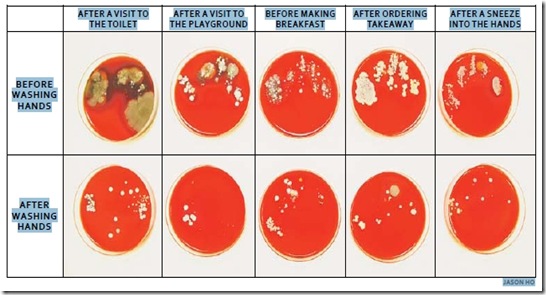
090616-MicrobesAfterWashing
An experiment reveals the amount of bacteria that flourishes on hands that are not cleaned thoroughly

Eveline Gan, eveline@mediacorp.com.sg

 
I WASH my hands frequently. While I don’t think there’s anything wrong with this, my husband sees it as a sign of obsessive compulsive disorder. He can’t understand why I carry a hand sanitiser in my bag, or why I insist that he washes his hands before feeding our daughter.

He thinks I’m paranoid. I think it’s just good hygiene.

Seeking to prove my point, I conducted an experiment (see The Experiment box) with the help of the Health Promotion Board (HPB) and a microbiologist. The mission: To find out how much germs my hands pick up throughout the day and whether washing them makes a difference in reducing the amount.

My worries were well-founded: Without a proper washing, even clean-looking hands can brim with microscopic germs.

Our hands are never totally germ-free, said Dr Tan Ai Ling, a senior consultant microbiologist at Singapore General Hospital’s (SGH) department of pathology.

She explained that there are two types of micro-organisms on our hands: While the resident flora is part of our skin, the transient flora is picked up from the environment.

“Most of the time, the micro-organisms are harmless. But if we pick up something that is pathogenic, which can cause infection in humans, we may fall ill,” Dr Tan said.

She added that the risk of illness also depends on factors such as our immunity and the amount of germs on our hands.

Common infectious germs include diarrhoea-causing E Coli and salmonella, and viruses such as the influenza virus and Norovirus, which causes gastroenteritis.

ENTER GOOD OL’ SOAP AND WATER

Washing your hands regularly greatly reduces the risk of passing on the flu and other infectious diseases that spread through human contact, said Mr Lam Pin Woon, CEO of HPB.

To help people protect themselves against airborne and droplet-borne diseases, HPB launched a hand-washing campaign earlier this month called “Stop the Horror with Soap and Water”.

According to Mr Lam, cleaning your hands with soap and water for 15 seconds reduces germ count by 50 to 90 per cent. For a 99 per cent reduction in germs, wash for 30 seconds.

But simply lathering your hands isn’t good enough.

“You’ll also need to rub them vigorously. Friction is required to effectively remove bacteria on the skin,” said Dr Tan.

The HPB recommends an eight-step technique: Wet your hands under running water, apply soap and lather well. Scrub all surfaces in the following order - palm to palm, between the fingers, back of the hands, base of both thumbs, back of the fingers, fingernails and wrists.

Finally, rinse both hands and wipe them dry with a paper towel.

The experiment 

The aim: To find out if washing my hands regularly with soap and water can effectively reduce the amount of germs on them.

The method: As I went about my day, I would press my fingers on specially designed plates provided by Dr Tan before and after washing my hands. Any bacteria would be transferred onto the plates.

I made the imprints before preparing breakfast for my daughter, and after visiting the office toilet and sneezing. I also did it after taking my daughter to the playground and before having dinner with my family in a crowded coffeeshop.
The next day, I sent the plates to SGH’s senior consultant microbiologist Dr Tan Ai Ling, who interpreted the results.

The conclusion: Depending on the environment I was in, I had picked up bacteria including several bacillus species and staphylococcus. I even picked up mould at the playground. I shudder to think of all the germs I would have unwittingly fed my toddler had I not washed my hands before preparing her breakfast and feeding her dinner.

According to Dr Tan, the results showed that the amount of bacteria was much reduced - by at least 50 per cent - by hand washing.

“The study showed that the transient flora, or micro-organisms picked up from the environment, was easily got rid of by proper hand washing with soap and water,” she said.

The next best thing after the sink

If you’re at a hawker centre and can’t find a sink in which to wash your hands, alcohol-based hand sanitisers or wet wipes are the next best defence against germs.

According to Dr Tan, alcohol kills bacteria. But this method will only work if your hands are not covered by organic substances such as mucus or blood, as alcohol does not completely get rid of the germs that hide in these substances.
Not all alcohol-based sanitisers are equally effective, though.

Whether you’re using alcohol-based wipes or rubs, the alcohol concentration should be above 60 per cent for it to effectively kill germs, said Raffles’ Medical senior physician, Dr Wong Wei Mon.

From TODAY, Health – Tuesday, 16-Jun-2009

----------
Then, let RESERVE do its work for you!
----------